
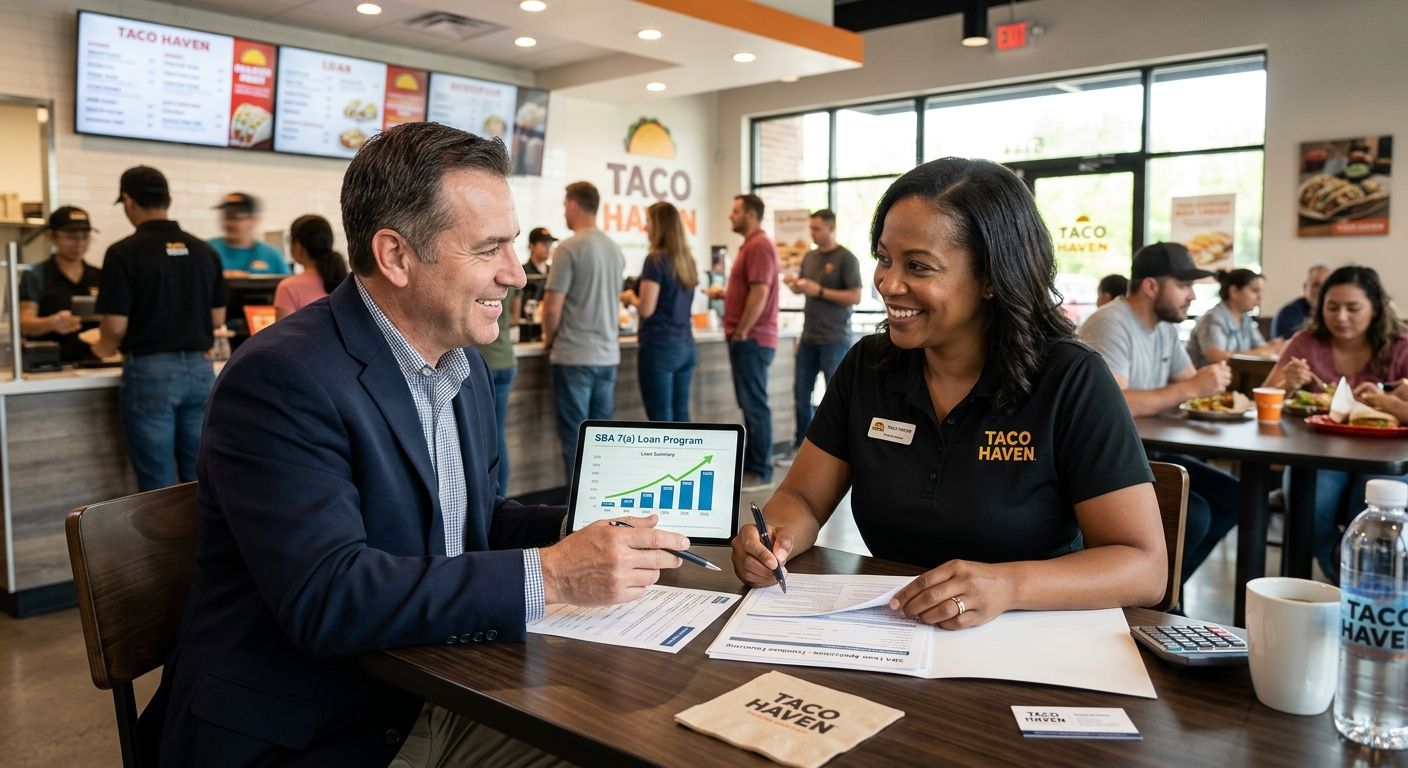
SBA loans for franchise owners are government-backed loans used to fund a new unit, buy an existing franchise resale, or expand an existing location, with a lender assuming reduced risk because the U.S. Small Business Administration guarantees a portion of the balance. Franchise owners face one extra layer that independent business owners don't: the franchisor's agreement, territory rights, and brand standards all get underwritten alongside the borrower's own financials.
- SBA loans for franchise owners work through 7(a), 504, and Express programs, with 7(a) covering most new-unit and resale purchases in 2026.
- Your franchise must appear on the SBA Franchise Directory before a lender will process the loan.
- Total capital need usually exceeds the franchise fee alone once build-out, equipment, and 3-6 months of working capital are added.
- BlackMound works with SBA lenders for small businesses alongside working capital and equipment financing for franchise owners who need faster non-SBA options.
- Weak personal credit or an unreviewed franchise agreement are the two most common reasons franchise SBA applications stall in 2026.
Why SBA loans matter for franchise owners
Franchise financing carries a built-in advantage over an independent startup loan: the franchisor already has a track record, a tested operating model, and often a relationship history with SBA lenders. That track record lowers perceived risk, which is why many franchise brands appear pre-approved on the SBA Franchise Directory with terms already negotiated for their system.
The tradeoff is documentation. A franchise SBA loan pulls in the franchise disclosure document (FDD), the franchise agreement, and sometimes a franchisor addendum that the lender reviews before touching your personal financials. Independent business owners skip that step entirely — franchise owners cannot.
Franchise resales add another wrinkle: lenders want two to three years of the unit's actual financial statements, not just the franchisor's system-wide averages. A strong system with a weak individual location still gets scrutinized location by location.
Confirm your franchise is SBA-eligible
Not every franchise brand qualifies automatically, and eligibility gets checked before anything else moves forward.
- Search the brand name in the SBA Franchise Directory to confirm it's listed for 2026
- If unlisted, ask the franchisor whether they've submitted a new franchise agreement addendum
- Confirm the specific franchise agreement version matches what's on file with the SBA
- Check whether the franchisor requires a specific site or territory approval before funding
- Verify there's no pending litigation or SBA delisting flag on the brand
Choose the right SBA loan type for your franchise stage
The program you need depends on whether you're opening a new unit, buying a resale, or expanding.
- SBA 7(a) covers new-unit build-out, franchise fees, working capital, and resale purchases up to $5 million
- SBA 504 fits owners buying commercial real estate or heavy equipment tied to the franchise, structured with a bank and a Certified Development Company
- SBA Express moves faster on smaller amounts, useful for a second or third unit where speed matters more than the largest possible loan size
- A franchise resale loan needs two to three years of the specific location's financials, not brand-wide averages
- Multi-unit operators adding a location often qualify for 7(a) even while still paying down a prior SBA loan on unit one
Gather your franchise-specific documents
Lenders process franchise files differently than independent business files, and missing one document restarts the clock.
- Full Franchise Disclosure Document (FDD), all 23 items, current version
- Signed or draft franchise agreement with territory and renewal terms
- Franchisor's item 19 financial performance representations, if disclosed
- Personal financial statement and three years of personal tax returns
- Business tax returns and P&L for resales, or a detailed pro forma for new units
- Site lease or letter of intent for the specific location
Strengthen your personal and business credit profile
Franchise brand strength doesn't override a borrower's own credit file — SBA lenders still underwrite the individual.
- Pull your personal credit report and dispute errors before applying, not after
- Pay down revolving balances below 30% utilization for 60-90 days before submission
- Resolve any past-due business debt, even small trade accounts
- Document at least 10-20% of the total project cost as your own equity injection
- If your credit sits below 650, a business loan for bad credit may bridge the gap while you rebuild toward SBA eligibility
Calculate your real capital need
The franchise fee is the number franchisors advertise, but it's rarely the number you actually need to borrow.
- Franchise fee (fixed, published in the FDD)
- Build-out and leasehold improvements specific to the site
- Equipment, signage, and point-of-sale systems required by brand standards
- Initial inventory or supply order the franchisor mandates
- 3-6 months of working capital to cover payroll and rent before the location breaks even
- Contingency reserve, typically 10% of the total project cost
Add these together before requesting a loan amount — undercapitalized franchise openings are one of the most common reasons units fail in the first 18 months.
Compare SBA lenders instead of walking into one bank
SBA loans for franchise owners are not one-size-fits-all across lenders — approval speed, documentation tolerance, and franchise-specific experience vary widely.
- Ask directly how many loans the lender has closed for your specific franchise brand in 2026
- Compare timelines: some SBA lenders close in 45 days, others take 90+
- Check whether the lender requires a franchisor certification letter upfront or later in underwriting
- Ask what happens if your franchise isn't on the SBA Directory yet
- Reviewing multiple SBA lenders for small businesses side by side surfaces which ones actually specialize in franchise files versus general small business lending
Prepare for the franchisor's role in underwriting
The franchisor isn't just a reference — many lenders require direct franchisor sign-off before closing.
- Request the franchisor's standard SBA addendum early; drafting one from scratch adds weeks
- Confirm territory rights are exclusive and match what the lender's appraisal will assume
- Ask the franchisor for a list of preferred or approved lenders — this shortens diligence significantly
- Understand renewal terms; a lender won't fund a location with under 5 years left on the franchise agreement without addressing it
A franchise SBA application moves fastest when the franchisor paperwork and the borrower's credit file are both clean on day one — waiting to fix either after submission adds 30-60 days.
Comparison: financing options for franchise owners
| Option | Best for | Key limitation |
|---|---|---|
| SBA 7(a) | New-unit purchase, resale, or working capital up to $5M | 45-90 day close, heavy documentation |
| SBA 504 | Real estate or major equipment tied to the franchise | Requires a bank plus a Certified Development Company |
| SBA Express | Smaller, faster loans for a second or third unit | Lower maximum loan size than standard 7(a) |
| Equipment financing | Kitchen, retail fixtures, or vehicles required by brand standards | Doesn't cover franchise fee or working capital |
| Working capital / MCA | Bridging cash flow before SBA funds land | Higher cost than SBA for the same dollar amount |
For build-out-heavy concepts like quick-service restaurants or fitness studios, equipment financing often closes faster than SBA and covers the specific fixtures brand standards require, while SBA still handles the larger real estate or working capital piece.
Get matched with a franchise-ready lender
Compare SBA and non-SBA funding for your franchise in one application.
Common mistakes franchise owners make
- Budgeting only the franchise fee. Owners underestimate build-out and working capital, then run short in month four.
- Skipping the franchisor addendum until the lender asks. This single document delays more franchise SBA closings in 2026 than any credit issue.
- Assuming brand-wide item 19 numbers apply to their specific site. Lenders underwrite the location, not the system average.
- Applying to one lender only. Franchise experience varies enormously bank to bank; a generalist lender can take twice as long as a franchise specialist.
- Ignoring renewal terms on the franchise agreement. A lease or agreement with under 5 years remaining stalls underwriting until renegotiated.
First-time franchise buyers with limited business history sometimes need a startup business loan to cover pre-opening costs while the SBA application is still in underwriting — the two aren't mutually exclusive.
FAQ
What’s the best SBA loan for a franchise owner in 2026?
SBA 7(a) is the best fit for most franchise owners in 2026 because it covers the franchise fee, build-out, and working capital in one loan up to $5 million. SBA 504 works better when the bulk of the cost is real estate or heavy equipment.
Is SBA financing better than a franchisor’s in-house financing program?
SBA financing generally offers lower rates and longer terms than franchisor in-house programs, but in-house financing can close faster with less documentation. Compare both before committing, since franchisor programs vary by brand.
How much does an SBA loan for a franchise cost to originate?
SBA loans carry a guarantee fee set by the SBA plus lender closing costs, both of which vary by loan size and lender. Ask each lender for a full fee breakdown before comparing offers.
Does my franchise need to be on the SBA Franchise Directory?
Yes, your franchise brand must appear on the SBA Franchise Directory before a lender will process a 7(a) or 504 application. If it isn’t listed, the franchisor needs to submit its franchise agreement for review first.
Can I get an SBA loan to buy an existing franchise resale?
Yes, SBA 7(a) funds franchise resales, but lenders require two to three years of that specific location’s financial statements rather than brand-wide averages. Weak individual-unit performance can slow approval even in a strong system.
How long does an SBA franchise loan take to close in 2026?
Standard SBA 7(a) loans for franchises typically close in 45 to 90 days depending on the lender and how complete the franchisor documentation is upfront. SBA Express moves faster for smaller loan amounts.
What credit score do I need for an SBA franchise loan?
Most SBA lenders look for a personal credit score above 650, though the exact threshold varies by lender and franchise brand strength. Owners below that range often start with a bad credit business loan while rebuilding credit.
Do I need real estate for an SBA franchise loan?
No, SBA 7(a) funds leased locations without requiring real estate ownership. SBA 504 is the program built specifically for franchise owners purchasing the underlying property.
One last thing
The franchisor's SBA addendum, not the borrower's credit file, is the single most common bottleneck in franchise SBA closings during 2026 — get that document requested and signed before you submit anything else, and the rest of the file moves in weeks instead of months.
Related guides
- Equipment financing companies for franchise build-outs
- Commercial real estate loans for franchise property purchases


